
Read it in three steps
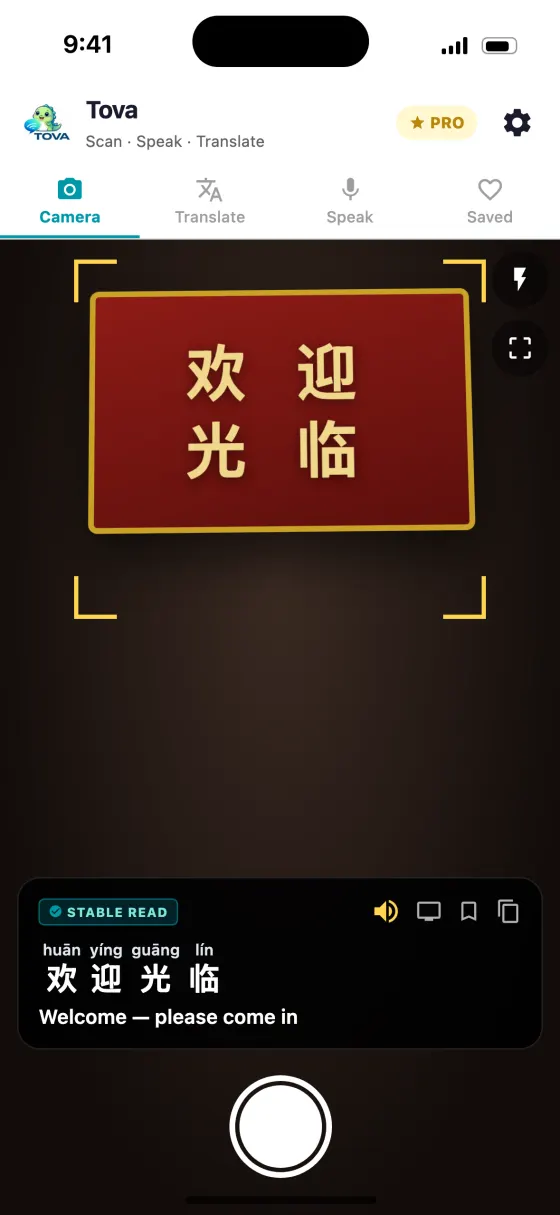
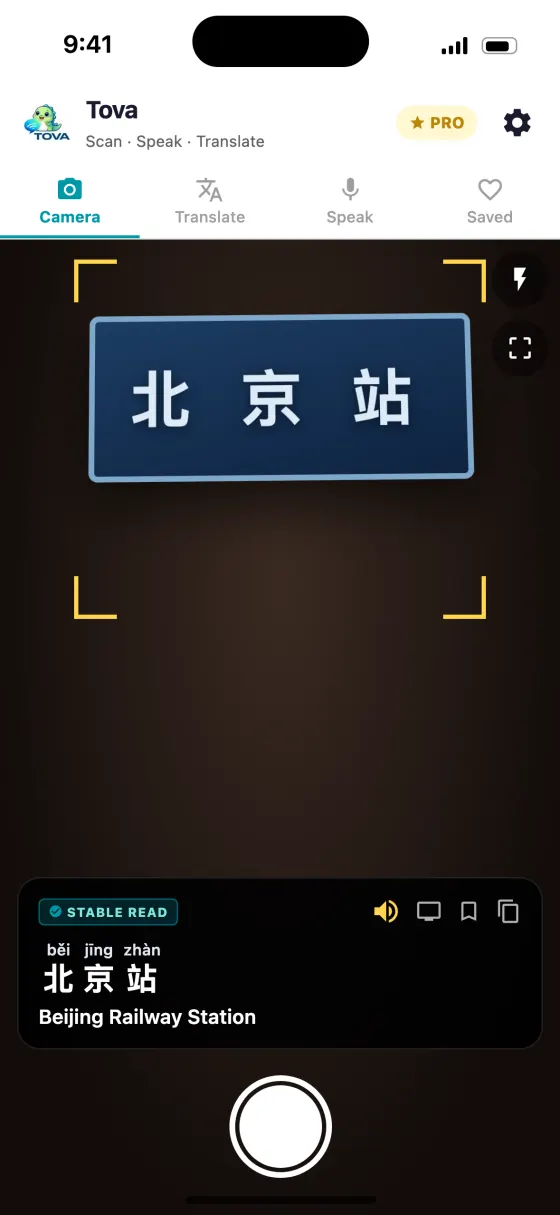
- Pick Chinese as the scan language, aim the camera at the sign and tap the shutter.
- Read the English, with pinyin above each character in the panel at the bottom of the screen. Tap to hear it spoken.
- Switch the scan language to Cantonese for Hong Kong or Macau signs, or to any of the 11 writing systems Tova reads.
Signs repeat themselves
A Chinese menu has hundreds of possible dishes. Chinese signs do not. The same fifty or so words turn up on every metro platform, shop door and toilet corridor from Beijing to Kunming, and most of them are two characters long.
That makes signs the easiest Chinese you will ever read. Learn to recognise 出口 (exit), 禁止 (forbidden) and 洗手间 (toilet) by shape and you are already reading a large share of what is on the walls. The tables below are grouped by where you will meet the words, with Hanyu Pinyin and tone marks so you can say them if you need to ask.
Mainland China uses simplified characters, which is what these tables show. Hong Kong, Macau and Taiwan use traditional characters, so 出口 looks the same but 电梯 becomes 電梯 and 厕所 becomes 廁所. Tova reads both.
Directions and exits
The first group is the one that gets you out of a building. 口 means mouth, and on a sign it means an opening — a way in or out.
| Characters | Pinyin | Meaning |
|---|---|---|
| 出口 | chūkǒu | Exit |
| 入口 | rùkǒu | Entrance |
| A口 / A出口 | A kǒu | Exit A — metro exits are lettered, sometimes numbered too (A1, A2) |
| 安全出口 | ānquán chūkǒu | Emergency exit — the green running-man sign |
| 电梯 | diàntī | Lift / elevator |
| 扶梯 | fútī | Escalator |
| 楼梯 | lóutī | Stairs |
| 推 | tuī | Push |
| 拉 | lā | Pull |
| 服务台 | fúwùtái | Information or service desk |
Swipe to see the whole table →
Transport
Station vocabulary — ticket halls, platforms, transfers, which of four stations in one city you actually want — has its own guide: Chinese train station signs. These are the words you meet between the stations.
| Characters | Pinyin | Meaning |
|---|---|---|
| 地铁 | dìtiě | Metro / subway |
| 公交车 | gōngjiāochē | City bus |
| 公交站 | gōngjiāozhàn | Bus stop |
| 出租车 | chūzūchē | Taxi |
| 停车场 | tíngchēchǎng | Car park / parking lot |
| 机场 | jīchǎng | Airport |
| 售票处 | shòupiàochù | Ticket office |
| 方向 | fāngxiàng | Direction — 往机场方向 means towards the airport |
| 终点站 | zhōngdiǎnzhàn | Terminus, last stop on the line |
Swipe to see the whole table →
Shops and services
| Characters | Pinyin | Meaning |
|---|---|---|
| 营业时间 | yíngyè shíjiān | Opening hours |
| 营业中 | yíngyè zhōng | Open now |
| 休息 | xiūxi | Closed (literally, resting) |
| 银行 | yínháng | Bank |
| 取款机 | qǔkuǎnjī | ATM, cash machine |
| 药店 | yàodiàn | Pharmacy |
| 医院 | yīyuàn | Hospital |
| 超市 | chāoshì | Supermarket |
| 便利店 | biànlìdiàn | Convenience store |
| 酒店 | jiǔdiàn | Hotel — despite 酒 meaning alcohol |
| 餐厅 | cāntīng | Restaurant |
| 收银台 | shōuyíntái | Checkout, cashier |
| 打折 | dǎzhé | Discount — 八折 means 20% off, you pay 80% |
Swipe to see the whole table →
Warnings and prohibitions
Two characters do most of the work here. 禁止 (jìnzhǐ) is a flat "forbidden". 请勿 (qǐng wù) is the polite version, "please do not". Either way, what follows is the thing you should not do.
| Characters | Pinyin | Meaning |
|---|---|---|
| 禁止吸烟 | jìnzhǐ xīyān | No smoking |
| 请勿吸烟 | qǐng wù xīyān | Please do not smoke |
| 禁止入内 | jìnzhǐ rùnèi | No entry |
| 闲人免进 | xiánrén miǎn jìn | Staff only (literally, idle people keep out) |
| 禁止拍照 | jìnzhǐ pāizhào | No photography |
| 请勿触摸 | qǐng wù chùmō | Do not touch |
| 小心 | xiǎoxīn | Caution, be careful |
| 小心地滑 | xiǎoxīn dì huá | Caution, slippery floor |
| 小心台阶 | xiǎoxīn táijiē | Mind the step |
| 危险 | wēixiǎn | Danger |
| 施工 | shīgōng | Construction work |
Swipe to see the whole table →
Toilets
| Characters | Pinyin | Meaning |
|---|---|---|
| 厕所 | cèsuǒ | Toilet — the plain word |
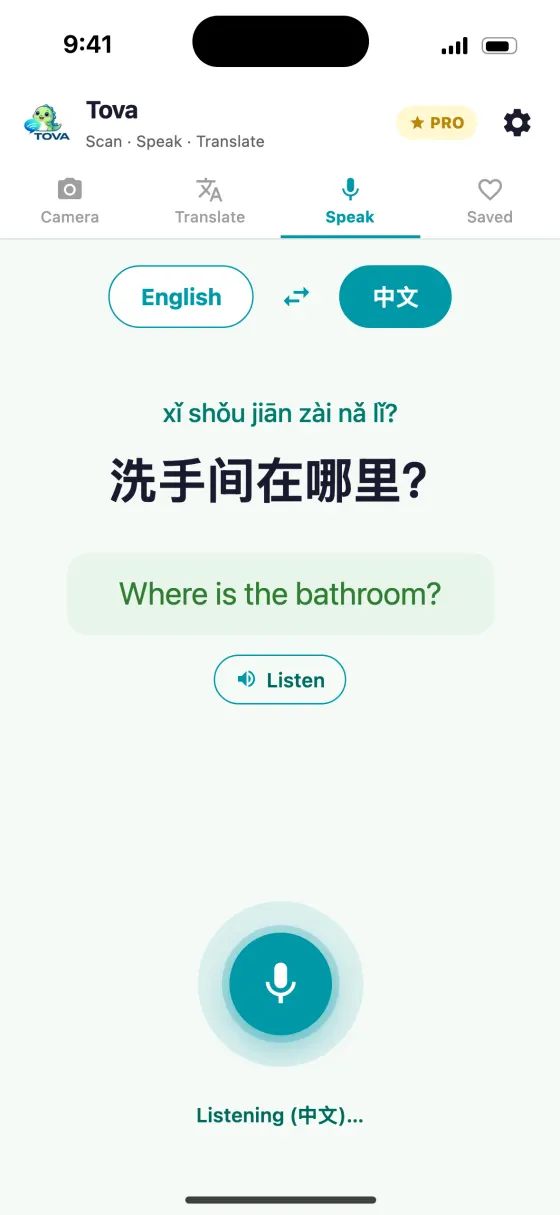
| 卫生间 | wèishēngjiān | Toilet, bathroom — the polite word on most signs |
| 男 | nán | Men |
| 女 | nǚ | Women |
| 无障碍 | wúzhàng'ài | Accessible, step-free |
| 第三卫生间 | dì-sān wèishēngjiān | Family or assisted toilet (literally, the third toilet) |
| 坐便 | zuòbiàn | Sit-down toilet |
| 蹲便 | dūnbiàn | Squat toilet |
| 有人 | yǒu rén | Occupied |
| 无人 | wú rén | Vacant |
Swipe to see the whole table →
Finding the right metro exit
Large Chinese metro stations can have a dozen exits spread over several streets. Coming up the wrong one can cost you ten minutes and a road crossing.
- Look up the exit before you arrive. Map apps and hotel directions usually name an exit letter — "Exit D" or "D口". Write it down.
- Follow 出口 first, then the letter. On the platform, overhead boards show 出口 with an arrow. Nearer the gates the boards split by letter.
- Read the landmark list under each letter. Exit boards list the streets, malls and buildings above that exit. This is where the camera earns its place: capture the board and you get every landmark in English with its pinyin, which you can match against the name your hotel sent you.
- Check for 无障碍 if you have luggage. Not every exit has a lift or escalator. The accessible ones are marked, usually with the wheelchair symbol as well.
A sign you do not understand on a door
You reach a door with red characters and no English. Before you push it, look for 禁止 or 请勿 at the start. If either is there, whatever comes next is not allowed.
禁止入内 and 闲人免进 both mean you should not go through. 禁止吸烟 in a stairwell means the stairwell is not the smoking area, however many cigarette ends are on the floor. If the sign is longer than four or five characters, capture it: long signs are often rules or opening hours, and the detail matters.
Shop doors work the same way. 营业时间 followed by numbers is the opening hours, written on a 24-hour clock. 休息 on its own, often hung on a card, means closed for now.
Common mistakes
- Reading 出 and 入 the wrong way round. 出 (chū) is out, 入 (rù) is in. 入 is easy to confuse with 人 (person) — the strokes lean the other way.
- Assuming 酒店 is a bar. It is a hotel. A bar is usually 酒吧 (jiǔbā).
- Reading a discount as a percentage off. 七折 means you pay 70% of the price, not that 70% is taken off.
- Trusting the English on the sign. Many signs carry an English line, and some are machine-translated nonsense. The characters are the reliable part.
- Waiting for a live read on a stylised sign. Calligraphy, neon and very old shopfronts are hard for any camera. Get closer, tap the shutter for a still capture, and accept that a heavily decorative sign may still come back wrong.
Why pinyin above the characters helps
A translation tells you a sign says Exit B. It does not help you find Exit B again when the next board has no English, and it does not help you ask. With the pinyin printed above each character you start to connect the shape 出口 with the sound chūkǒu, and after a few days you stop needing the phone for the common ones. If you want to go further than signs, reading Chinese characters with pinyin covers how tones work and why simplified and traditional are the same language.
Tova keeps working when the network does not. Text recognition runs on your phone, and if Tova cannot reach its servers — no signal, flight mode, or blocked in mainland China — translation falls back to on-device translation, with pinyin still shown.
About this guide
What's the best app to translate Chinese signs while travelling?
Tova Translate reads Chinese signs from your camera and shows the English with Hanyu Pinyin above each character, in a panel at the bottom of the screen. It works in mainland China without a VPN because it falls back to on-device translation when it cannot reach its servers, and it is free to download on iPhone, iPad and Android.
Does the sign translator work offline in China?
Yes. Text recognition runs on the phone, and when Tova cannot reach its servers it switches to on-device translation automatically. Download the free offline packs in Settings before you travel so the language you need is already on the device. Pinyin is still shown offline.
Can it read vertical or stylised Chinese signs?
Vertical text is fine. Stylised signs are harder: calligraphy, neon and weathered shopfronts can confuse any camera. Tap the shutter for a still capture rather than relying on the live scan, and if it still comes back wrong, try a closer, straighter shot.
What if the sign is Cantonese, not Mandarin?
Switch the scan language to Cantonese and Tova shows Jyutping instead of Hanyu Pinyin above the same characters. Hong Kong and Macau signs use traditional characters, which Tova also reads.
What does 禁止 mean on a sign?
禁止 (jìnzhǐ) means forbidden. Whatever follows it is not allowed: 禁止吸烟 is no smoking, 禁止入内 is no entry, 禁止拍照 is no photography. 请勿 (qǐng wù) is a politer way of saying the same thing.
How do I find the toilet sign in China?
Look for 卫生间 (wèishēngjiān), 洗手间 (xǐshǒujiān) or the plainer 厕所 (cèsuǒ). 男 is men and 女 is women. 无障碍 marks an accessible toilet, and 第三卫生间 is a family or assisted toilet.
Try it on the next menu or sign
Free on the App Store and Google Play. Works offline in China, no VPN.
Download on theApp StoreGet it onGoogle Play