
Read it in three steps
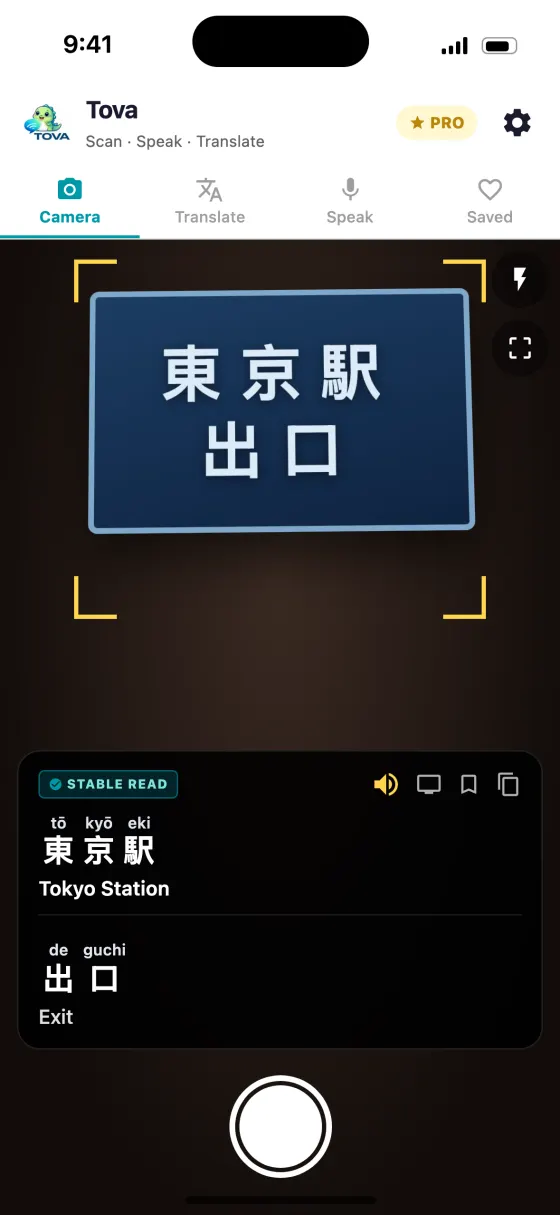
- Set the scan language to Japanese and point the camera at the sign.
- Tap the shutter and read the English meaning, with romaji above each character, in the panel below.
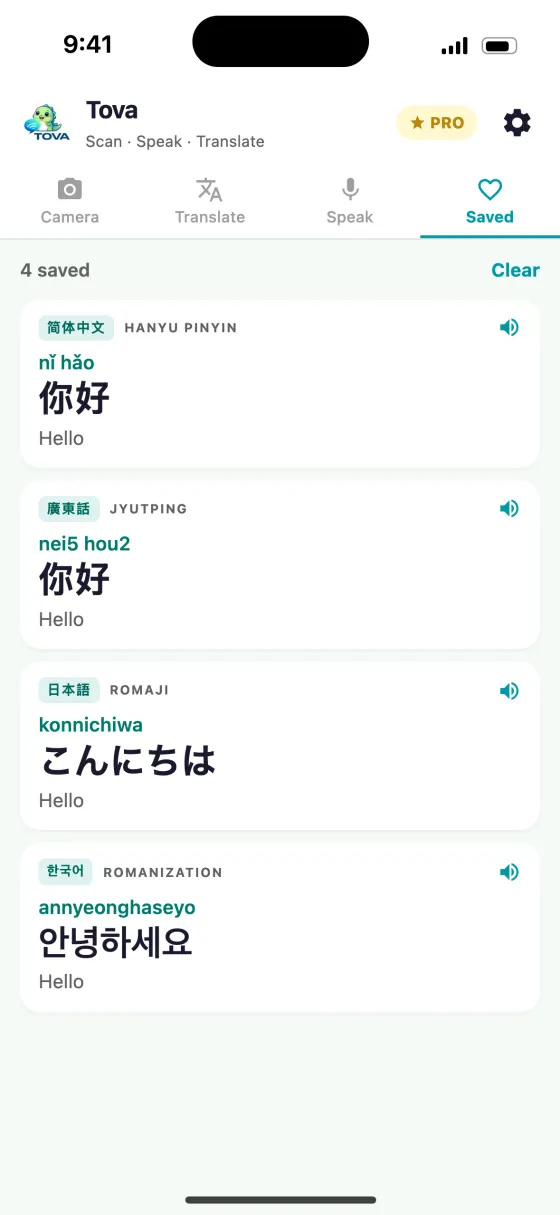
- Save the ones you will need again, like your station name or hotel address, to Favourites.
Where the English runs out
Big stations in Tokyo, Osaka and Kyoto have English on the main signs, and first-time visitors are often surprised how far that gets them. The trouble starts one layer down: the paper notice taped to a closed exit, the fare adjustment machine, the shop door that says it is shut today, the bus stop in a small town, the warning on a hiking trail.
Those signs use a small, repetitive vocabulary. The same forty or fifty words cover most of what you will meet, and many of them are two kanji long. Learn to recognise the shapes in the tables below and you can usually tell an exit from an entrance before your phone is out of your pocket.
If the scripts are new to you, reading Japanese with romaji covers hiragana, katakana and kanji, and the spelling rules that make romaji look odd.
Station signs
| Sign | Romaji | What it means |
|---|---|---|
| 駅 | eki | Station |
| 出口 | deguchi | Exit |
| 入口 | iriguchi | Entrance |
| 改札 | kaisatsu | Ticket gates |
| 乗り換え | norikae | Transfer — change trains here |
| のりば | noriba | Boarding area, for trains, buses or taxis |
| 番線 | bansen | Track number — 3番線 is track 3 |
| 方面 | hōmen | Towards — the direction a train is heading |
| 切符 | kippu | Ticket |
| 精算機 | seisanki | Fare adjustment machine — pay the difference here |
| チャージ | chāji | Top up an IC card |
| 各駅停車 | kakueki teisha | Local train — stops at every station |
| 快速 | kaisoku | Rapid — skips some stations |
| 急行 | kyūkō | Express |
| 特急 | tokkyū | Limited express — often needs an extra ticket |
| 終電 | shūden | Last train of the night |
| 上り / 下り | nobori / kudari | Towards / away from the main city on a line |
Swipe to see the whole table →
Exits and directions
| Sign | Romaji | What it means |
|---|---|---|
| 東口 | higashiguchi | East exit |
| 西口 | nishiguchi | West exit |
| 南口 | minamiguchi | South exit |
| 北口 | kitaguchi | North exit |
| 中央口 | chūōguchi | Central exit |
| 地下 | chika | Underground, basement |
| 階段 | kaidan | Stairs |
| エレベーター | erebētā | Lift |
| 非常口 | hijōguchi | Emergency exit |
Swipe to see the whole table →
Toilets, rules and warnings
| Sign | Romaji | What it means |
|---|---|---|
| お手洗い | otearai | Toilets |
| トイレ | toire | Toilet |
| 男 | otoko | Men |
| 女 | onna | Women |
| 禁煙 | kin'en | No smoking |
| 喫煙所 | kitsuenjo | Smoking area |
| 立入禁止 | tachiiri kinshi | No entry |
| 撮影禁止 | satsuei kinshi | No photography |
| 駐輪禁止 | chūrin kinshi | No bicycle parking |
| 危険 | kiken | Danger |
| 注意 | chūi | Caution |
| 押 | osu | Push — on a door |
| 引 | hiku | Pull — on a door |
Swipe to see the whole table →
Shops, restaurants and konbini
| Sign | Romaji | What it means |
|---|---|---|
| 営業中 | eigyōchū | Open |
| 準備中 | junbichū | Closed — getting ready to open |
| 定休日 | teikyūbi | Regular closing day |
| 本日休業 | honjitsu kyūgyō | Closed today |
| レジ | reji | Till, checkout |
| 割引 | waribiki | Discount |
| 半額 | hangaku | Half price |
| 税込 | zeikomi | Tax included |
| 賞味期限 | shōmi kigen | Best before |
| 消費期限 | shōhi kigen | Use by — do not eat after this |
| 両替 | ryōgae | Currency exchange, or change for a note |
| コインロッカー | koin rokkā | Coin lockers |
Swipe to see the whole table →
Changing trains
Transfers are where most people get lost, because a line can change operator, colour and name at the same station.
- Follow 乗り換え, not 出口. Transfer signs keep you inside the gates. Following an exit sign by mistake puts you outside, and in some stations that means paying again.
- Match the line colour and letter. Tokyo Metro and Toei lines each have a colour and a letter, and every station has a number, like G09. Those appear on the signs even where the English does not.
- Read 方面 on the platform. Each platform names the end of the line or a big stop the train is heading towards. Check it against your map app before you board.
- Check the train type. A 快速 or 特急 can run straight through your station. If yours is small, a 各駅停車 is the safe choice.
- Scan the notice board if something is wrong. Delays and suspensions often go up in Japanese first. Tap the shutter on the board, then pinch to zoom into the part you need and translate just that region — it is far more reliable than reading a whole crowded board in one go.
Finding the right exit
- Choose the exit before you leave the platform. Large stations have dozens of exits, numbered like A1 and B7 or named by direction, and they can be ten minutes' walk apart above ground.
- Get the exit from your map app. Most walking directions name a station exit. Look for that number or 東口, 西口 and so on in yellow signs above the platform.
- Check the neighbourhood map by the gates. It shows which exit leads to which street. Scan it if the landmark names are only in Japanese.
- If you exit wrong, go back through the gates. In many stations that is quicker than walking round the outside.
At a konbini
Convenience stores are easy to use without Japanese, but the staff will ask a few quick questions at the till.
- 温めますか (atatamemasu ka) — do you want it heated? Nod for a bento, shake your head for a sandwich.
- 袋はご利用ですか (fukuro wa goriyō desu ka) — do you need a bag? Bags cost a few yen. はい (hai) for yes, 大丈夫です (daijōbu desu) for no thanks.
- ポイントカード (pointo kādo) — do you have a points card? いいえ (iie), no, is the answer.
- Check 消費期限 on anything fresh. Dates are usually written year, month, day.
Common mistakes
- Mixing up 入口 and 出口. Both end in 口, mouth or opening. 入 goes in, 出 goes out. The first kanji is the whole difference.
- Reading 準備中 as open. A shop with its lights on and a sign saying junbichū is not ready for customers yet.
- Missing 定休日. Many restaurants close one fixed day a week. The door sign names the day, and it is easy to walk past it and wait.
- Taking a 特急 on a regular ticket. Limited expresses often need a surcharge ticket. The conductor will ask for it.
- Assuming English means complete. English signs cover the main route. Closures, detours and temporary notices are frequently Japanese only.
- Pointing the camera at a whole board from across the concourse. Get closer, or capture it and zoom in. Small text at a distance is where every camera translator, Tova included, gets things wrong.
Why the reading helps
A translation tells you a sign says Shimokitazawa. The romaji tells you how to say it to a station attendant, and it matches the name the train announcer uses. That matters when you are listening for your stop, not reading it.
Tova shows the romaji above each character in a panel at the bottom of the camera screen, with the English underneath, and you can tap to hear it. Kanji readings need a connection, because the same character is read differently in different names. Offline, Tova still translates the sign on your phone, but the romaji may not appear. Save your station and hotel address while you have signal. If Korea is next on the trip, translating Korean signs works the same way, with Revised Romanization.
About this guide
How do I translate a Japanese sign with my phone?
Open Tova, set the camera scan language to Japanese, point at the sign and tap the shutter. You get the English meaning and romaji above each character, so you can also say the place name aloud when you ask for directions.
Will it read vertical Japanese text?
Usually. Vertical text is common on shopfronts and older signs. If a vertical column comes out jumbled, capture the photo, zoom into that one column and translate just that region.
Does it work on the small print on station boards?
Zoom in first. After you take the shot you can pinch to magnify the photo and translate only the part you are looking at, which is far more reliable than trying to read a whole crowded board at once.
Do I need a data connection in Japan?
Not for a translation. When Tova cannot reach its servers it falls back to on-device translation, so you still get the English. Romaji for kanji does need a connection, so offline you may see the meaning without the reading.
What is the difference between 出口 and 改札?
改札, kaisatsu, is the line of ticket gates. 出口, deguchi, is the exit from the station to the street. You pass the 改札 first, then follow signs to the numbered 出口 you want.
What does 準備中 mean on a shop door?
It means the shop is preparing and not open yet, or closed between lunch and dinner. The sign for open is 営業中, eigyōchū.
Try it on the next menu or sign
Free on the App Store and Google Play. Works offline in China, no VPN.
Download on theApp StoreGet it onGoogle Play