
Read it in three steps
- Set the scan or voice language to Cantonese (廣東話).
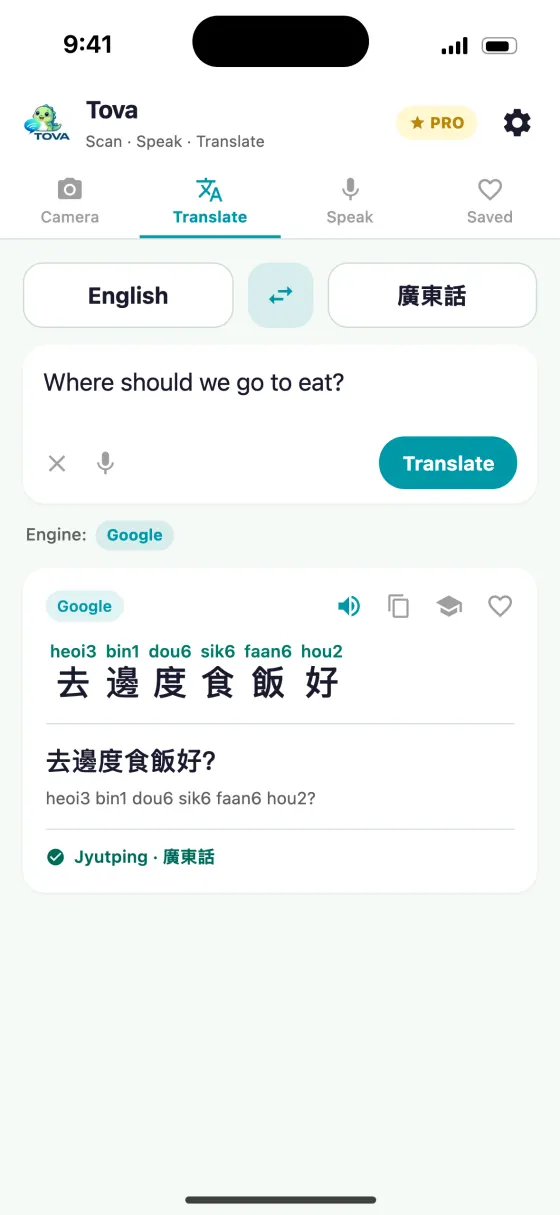
- Point the camera at a sign or menu and tap the shutter, or use the Speak tab. Tova shows Jyutping above each character, with the translation underneath.
- Tap Listen to hear the result read aloud, or save the phrases you will need again.
Cantonese is not Mandarin with an accent
Cantonese is the everyday language of Hong Kong, Macau and much of Guangdong, including Guangzhou. It shares most of its characters with Mandarin, but the sounds are different enough that a Mandarin speaker and a Cantonese speaker cannot follow each other in conversation.
That is the problem with using Hanyu Pinyin in Hong Kong. Pinyin is built for Mandarin. Put pinyin above a Cantonese menu and you get the Mandarin reading of every character, which is not what anyone in the restaurant will say. 飲茶, the word for going out for dim sum, is yǐn chá in Mandarin and jam2 caa4 in Cantonese. Say the first in a Hong Kong teahouse and you will be understood only because the staff guess.
Jyutping is the romanisation the Linguistic Society of Hong Kong designed for Cantonese. It is what Tova uses when you set the language to Cantonese, and it is what the free Jyutping converter on this site produces from any text you paste.
The six tones, briefly
Jyutping marks tone with a number after each syllable rather than an accent over a vowel. Cantonese has six tones, and changing the tone changes the word. The classic set uses the syllable si:
| Characters | Jyutping | Meaning |
|---|---|---|
| 詩 | si1 | Tone 1, high level — poem |
| 史 | si2 | Tone 2, high rising — history |
| 試 | si3 | Tone 3, mid level — try |
| 時 | si4 | Tone 4, low falling — time |
| 市 | si5 | Tone 5, low rising — market, city |
| 事 | si6 | Tone 6, low level — matter, thing |
Swipe to see the whole table →
Same characters, different sounds
The same characters read in Mandarin pinyin and in Jyutping. None of these are close enough to swap.
| Characters | Mandarin pinyin | Cantonese Jyutping |
|---|---|---|
| 香港 | Xiānggǎng | hoeng1 gong2 |
| 廣州 | Guǎngzhōu | gwong2 zau1 |
| 澳門 | Àomén | ou3 mun2 |
| 你好 | nǐ hǎo | nei5 hou2 |
| 飲茶 | yǐn chá | jam2 caa4 |
| 出口 | chūkǒu | ceot1 hau2 |
| 一 | yī | jat1 |
| 食 | shí | sik6 |
Swipe to see the whole table →
Characters you will only see in Cantonese
Written Cantonese uses a handful of characters that standard written Chinese does not, and they are everywhere on Hong Kong menus, shop notices and adverts. A Mandarin-only reader stumbles on every one of them.
| Characters | Jyutping | Meaning |
|---|---|---|
| 唔 | m4 | Not — 唔係 (m4 hai6) is "no, it isn't" |
| 嘅 | ge3 | Possessive, like 's — 我嘅 (ngo5 ge3) is "mine" |
| 喺 | hai2 | To be at, in — 佢喺度 (keoi5 hai2 dou6) is "he's here" |
| 冇 | mou5 | Don't have, there isn't |
| 啲 | di1 | Some, a little — 一啲 (jat1 di1) |
| 咗 | zo2 | Marks something done — 食咗 (sik6 zo2) is "have eaten" |
| 佢 | keoi5 | He, she, it |
| 乜嘢 | mat1 je5 | What |
Swipe to see the whole table →
Everyday words and phrases
| Characters | Jyutping | Meaning |
|---|---|---|
| 唔該 | m4 goi1 | Please, thank you (for a service), excuse me |
| 多謝 | do1 ze6 | Thank you (for a gift) |
| 唔好意思 | m4 hou2 ji3 si1 | Sorry, excuse me |
| 早晨 | zou2 san4 | Good morning |
| 係 | hai6 | Yes, it is |
| 有 | jau5 | Have, there is |
| 幾多錢 | gei2 do1 cin2 | How much is it |
| 呢個 | ni1 go3 | This one |
| 嗰個 | go2 go3 | That one |
| 喺邊度 | hai2 bin1 dou6 | Where is it |
| 唔使 | m4 sai2 | No need, don't bother |
| 埋單 | maai4 daan1 | The bill, please |
| 廁所 | ci3 so2 | Toilet |
| 八達通 | baat3 daat6 tung1 | Octopus card |
| 的士 | dik1 si2 | Taxi |
| 港鐵 | gong2 tit3 | MTR, the Hong Kong metro |
| 小巴 | siu2 baa1 | Minibus |
| 有落 | jau5 lok6 | Getting off — what you call out on a minibus |
Swipe to see the whole table →
At the table
| Characters | Jyutping | Meaning |
|---|---|---|
| 蝦餃 | haa1 gaau2 | Shrimp dumpling |
| 燒賣 | siu1 maai2 | Siu mai, open pork dumpling |
| 叉燒包 | caa1 siu1 baau1 | Barbecue pork bun |
| 腸粉 | coeng2 fan2 | Rice noodle roll |
| 奶茶 | naai5 caa4 | Hong Kong milk tea |
| 雲吞麵 | wan4 tan1 min6 | Wonton noodles |
| 走冰 | zau2 bing1 | No ice |
| 少甜 | siu2 tim4 | Less sweet |
| 好食 | hou2 sik6 | Delicious |
Swipe to see the whole table →
Ordering dim sum
- Find the order sheet. Most dim sum restaurants give you a printed sheet listing every dish, with a box to write the quantity. It is almost entirely characters.
- Capture the whole sheet. Tap the shutter once and Tova reads the full sheet, with Jyutping above each dish name and the English underneath. For the broader menu vocabulary — cooking methods, proteins, warning words — see how to read a Chinese menu.
- Mark the boxes, hand it over. You do not have to say anything. When a trolley or server comes past, 呢個 (ni1 go3, this one) and a point is enough.
- Ask for the bill with 唔該埋單. m4 goi1 maai4 daan1. A raised hand and a small scribbling gesture works too.
Taking a Hong Kong minibus
Minibuses do not stop at every stop unless someone asks. The route and fare are on a card at the front, usually in characters, so capture it before you get on if you are unsure you have the right one.
When your stop is coming, call out 有落 (jau5 lok6) — getting off — or 前面有落 (cin4 min6 jau5 lok6), getting off ahead. This is the one place where saying it matters more than showing it: the driver is watching the road, not your phone. Practise it with the Jyutping first and tap Listen to hear it.
Common mistakes
- Using pinyin in Hong Kong. It gives you the Mandarin reading. Many people in Hong Kong speak Mandarin, but it is not the language of the street.
- Dropping the tone numbers. Without them, si could be any of six words. The numbers are the pronunciation, not decoration.
- Mixing up 唔該 and 多謝. Both mean thank you. 唔該 is for a service — someone holding a door, bringing your food. 多謝 is for a gift or a favour.
- Reading Jyutping as English. j sounds like English y, so jau5 is close to "yow". c is like ts or ch, so caa4 is close to "chah". eo and oe are vowel sounds with no English equivalent.
- Expecting simplified characters. Hong Kong and Macau use traditional characters. Guangzhou uses simplified, but the spoken language there is still Cantonese.
What Tova does, and where it stops
Set the scan or voice language to Cantonese and Tova shows Jyutping above each character, in the panel at the bottom of the camera screen, with the translation underneath. The Speak tab shows the Jyutping for what was said. If you lose signal, translation falls back to on-device translation and Jyutping is still shown.
Written Cantonese is less standardised than Mandarin, and colloquial spellings vary between signs. Some slang and very new words will get a literal or odd translation. The Jyutping for common characters is dependable; treat the translation of heavily colloquial text as a guide.
About this guide
What's the best Cantonese translator app with Jyutping?
Tova Translate shows Jyutping above every Cantonese character across camera, voice and text, rather than relabelling Mandarin pinyin. It is free to download on iPhone, iPad and Android and works across Hong Kong, Macau and Guangdong.
Does Tova show Jyutping or just pinyin?
Jyutping for Cantonese, with tone numbers. Mandarin gets Hanyu Pinyin with tone marks separately. You choose which by setting the language to Cantonese or Mandarin.
Why is pinyin wrong for Cantonese?
Pinyin records Mandarin sounds. Cantonese reads the same characters differently and has six tones rather than four, so pinyin gives you the Mandarin pronunciation of a Cantonese sentence, which is not what people in Hong Kong say.
Will it work in Hong Kong and Macau?
Yes. Tova reads traditional characters, which Hong Kong and Macau use, and when there is no signal it falls back to on-device translation with Jyutping still shown.
Can it speak Cantonese aloud?
Yes. Tap Listen to hear a result read aloud, so you can use it with taxi drivers and shopkeepers, not just to read.
What do the numbers in Jyutping mean?
They are the tone. Cantonese has six: 1 high level, 2 high rising, 3 mid level, 4 low falling, 5 low rising and 6 low level. The same syllable with a different number is a different word.
Try it on the next menu or sign
Free on the App Store and Google Play. Works offline in China, no VPN.
Download on theApp StoreGet it onGoogle Play