
Read it in three steps
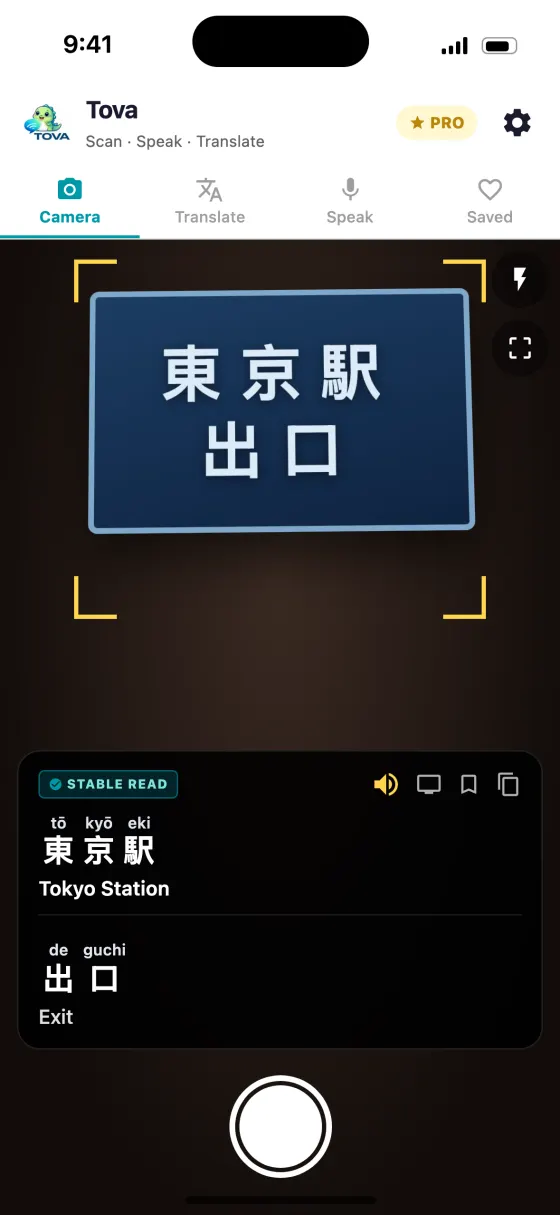
- Set the camera scan language to Japanese, point at the text and tap the shutter.
- Read the English translation with romaji above each character in the panel, so you can pronounce it before you can read kanji.
- Tap to hear it spoken, or save it to Favourites to practise later.
Three scripts on one line
Written Japanese uses three scripts at once, often in the same word. Romaji — Japanese written in the Latin alphabet — is the fourth, and it exists mostly for people who cannot read the other three yet. Knowing which script you are looking at tells you a lot before you know what any of it says.
Hiragana and katakana are syllable alphabets of 46 basic characters each: every character is one sound, and the sound never changes. Kanji are the characters borrowed from Chinese, and each has a meaning and usually several readings. A sentence like 駅で水を買います (eki de mizu o kaimasu, I buy water at the station) switches between kanji and hiragana four times.
| Script | Example | Romaji | What it is used for |
|---|---|---|---|
| ひらがな hiragana | さくら | sakura | Grammar, word endings, particles, and words with no common kanji |
| カタカナ katakana | コーヒー | kōhī | Loanwords, foreign names, brand names, and emphasis — coffee here |
| 漢字 kanji | 東京 | Tōkyō | Nouns and the stems of verbs and adjectives |
| Mixed | 食べます | tabemasu | Kanji for the meaning, hiragana for the grammar — to eat |
The romaji rules that trip people up
Signs, maps and rail networks in Japan use Hepburn romaji, the system built for English speakers. It is mostly spelled the way it sounds, with a handful of rules that catch everyone out.
Japanese schools also teach a second system, Kunrei-shiki, which writes the same sounds as si, ti, tu and hu — so 富士 can appear as Huzi instead of Fuji. You will rarely see it on signs, but it explains the odd spelling in older textbooks.
| Japanese | Romaji | The rule |
|---|---|---|
| 東京 とうきょう | Tōkyō | A long vowel is marked with a line, ō. Signs often drop it and write Tokyo; you may also see Toukyou |
| 大阪 おおさか | Ōsaka | おお is also a long o |
| 空気 くうき | kūki | Long u: air |
| ラーメン | rāmen | In katakana the dash ー lengthens the vowel before it |
| 切符 きっぷ | kippu | A small っ doubles the next consonant — hold it for a beat |
| 抹茶 まっちゃ | matcha | Before ch the doubling is written tch |
| 新聞 しんぶん | shinbun | ん is n. Traditional Hepburn writes m before b, m and p, so you will also see shimbun |
| 原因 げんいん | gen'in | An apostrophe separates ん from a following vowel: cause |
| こんにちは | konnichiwa | The particle は is read wa, not ha |
| 駅へ | eki e | The particle へ is read e, not he — to the station |
| 水を | mizu o | The particle を is read o — water, as the object |
| し ち つ ふ じ | shi chi tsu fu ji | Hepburn spells these as they sound to English ears |
Swipe to see the whole table →
One kanji, several readings
This is the part that makes kanji hard, and the reason a simple lookup table cannot give you romaji. Most kanji have a Chinese-derived reading (on'yomi), used mainly in compound words, and a native Japanese reading (kun'yomi), used mainly when the character stands alone or takes a hiragana ending. Some have more than one of each, and place names follow their own rules.
The right reading depends on the word the kanji sits in. The table shows how far apart they get.
| Kanji | Word | Romaji | Meaning |
|---|---|---|---|
| 生 | 生ビール | nama bīru | Draught beer — nama, raw or fresh |
| 生 | 学生 | gakusei | Student |
| 生 | 先生 | sensei | Teacher |
| 生 | 一生 | isshō | A whole lifetime |
| 生 | 生まれ | umare | Born in |
| 日 | 日本 | Nihon | Japan |
| 日 | 毎日 | mainichi | Every day |
| 日 | 日曜日 | nichiyōbi | Sunday |
| 日 | 今日 | kyō | Today — a special reading of the whole word |
| 人 | 日本人 | nihonjin | Japanese person |
| 人 | 一人 | hitori | One person, alone |
| 人 | 人口 | jinkō | Population |
| 下 | 地下鉄 | chikatetsu | Underground railway |
| 下 | 下北沢 | Shimokitazawa | A Tokyo neighbourhood |
| 日本橋 | 日本橋 in Tokyo | Nihonbashi | A district in Tokyo |
| 日本橋 | 日本橋 in Osaka | Nipponbashi | A different district, same kanji |
What that means for an app
Because the reading depends on context, Tova works out romaji for kanji from the whole phrase, on its servers, rather than one character at a time. That needs a connection. When you are offline Tova still translates on your phone, so you get the English, but the romaji for kanji may not appear. Hiragana and katakana never change their sound, so those are the easy part.
It also means romaji is a good guess, not a guarantee. Personal names and some place names have readings that even native speakers check. For a station, the romaji on the platform sign is the authority; for a person's name, ask them.
Asking for a place you cannot read
- Capture the name. Set the scan language to Japanese and tap the shutter on the sign, ticket or booking. The panel at the bottom of the camera screen shows the romaji above the characters and the English underneath.
- Tap to hear it. Listen before you say it. Japanese gives every syllable roughly the same length, so Shinjuku is shin-ju-ku, not SHIN-jook.
- Say it, then show it. Say the name and hold up the screen. The characters settle any confusion that the pronunciation starts.
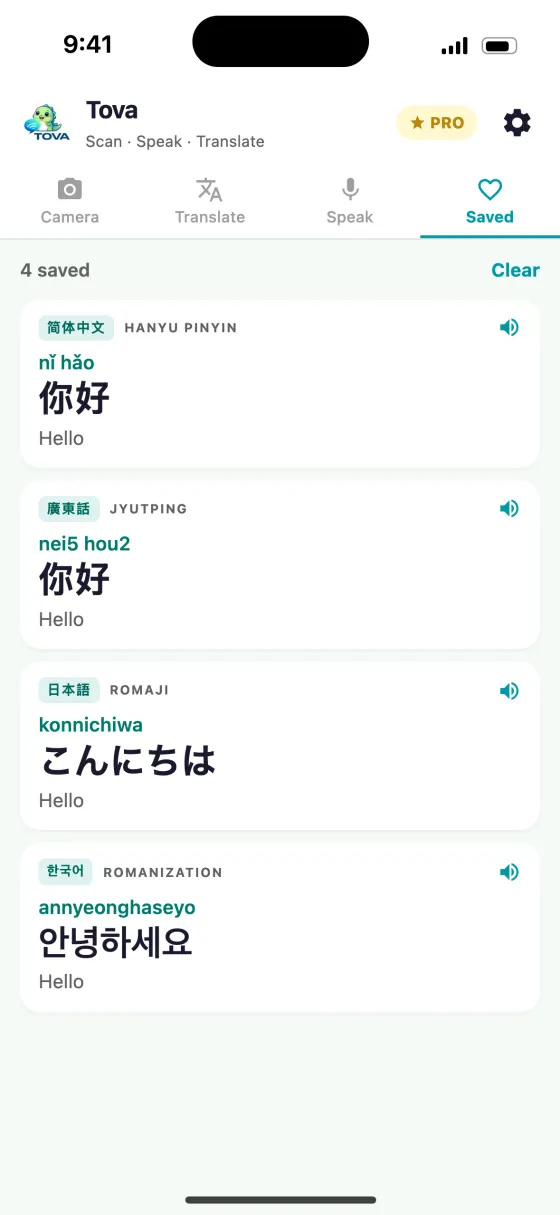
- Save it. Keep your hotel, your station and anywhere you are going back to in Favourites, so the reading is there when you have no signal. Free users can save five; Pro has no limit.
Reading a label in a konbini
- Look for katakana first. Many product names are loanwords. Sound out the katakana and you often recognise the English word underneath — サンドイッチ is sandoitchi, sandwich.
- Then the kanji. Flavours and ingredients are usually kanji: 鶏 for chicken, 豚 for pork. Scan the label if you need the detail.
- Check the dates. 賞味期限 (shōmi kigen) is best before; 消費期限 (shōhi kigen) is use by.
Common mistakes
- Reading romaji as English. Vowels are always a, i, u, e, o, as in Spanish or Italian. Sake is sa-ke, not sayk. Karaoke is ka-ra-o-ke.
- Dropping long vowels. They change the word. おばさん obasan is aunt; おばあさん obāsan is grandmother.
- Ignoring the small っ. 来て kite means come; 切手 kitte means postage stamp.
- Over-pronouncing u. In desu and masu the u is usually barely heard: dess, mass.
- Reading は as ha everywhere. It is ha inside a word and wa as a particle. こんにちは ends in wa.
- Expecting one reading per kanji. 生 alone has at least five common readings. If a romaji dictionary gives you one reading for a character, it is not the whole story.
Using romaji while you learn
Romaji is a bridge. Tova puts it above the characters rather than replacing them, so every time you read a reading you also see the script it belongs to. After a week of station names and menus, the common kanji start to look familiar without any study.
Put it to work on the two places it matters most on a trip: Japanese signs and station boards and Japanese menus. Both guides have tables of the words you will see most, with romaji.
About this guide
What is romaji?
Romaji is Japanese written in the Latin alphabet. It tells you how a word sounds without needing to read hiragana, katakana or kanji, so ラーメン becomes rāmen. Tova places romaji above the characters rather than replacing the Japanese, so you learn the script as you read.
Can an app put romaji above kanji from a photo?
Yes. Tova recognises Japanese text through the camera and shows romaji above the characters, with the English translation underneath. Kanji readings are worked out from the whole phrase, which needs a connection. Offline you still get the translation, but the romaji for kanji may be missing.
Why does one kanji have so many readings?
Kanji came from Chinese and kept a Chinese-derived reading alongside the native Japanese word for the same idea. Which one is used depends on the word, so 生 is nama in draught beer, sei in student, shō in lifetime and u in born. Place names often have readings of their own.
Should it be Tokyo, Tōkyō or Toukyou?
All three mean 東京. Tōkyō is Hepburn with the long vowels marked, Toukyou spells out the kana, and Tokyo is the everyday English spelling that drops the marks. The long vowels do matter when you say it.
Does it work on handwritten Japanese?
Often, yes. Tap the shutter instead of relying on the live scan, because the capture uses Apple's handwriting recognition. Printed signs and menus are the most reliable. Messy or very cursive handwriting can still fail.
Is the romaji reader free?
Yes. Camera translation, romaji readings and tap-to-listen audio are free, with ads. Tova Pro removes ads and adds unlimited saved phrases, Common replies and three-way Boardroom conversations.
Try it on the next menu or sign
Free on the App Store and Google Play. Works offline in China, no VPN.
Download on theApp StoreGet it onGoogle Play